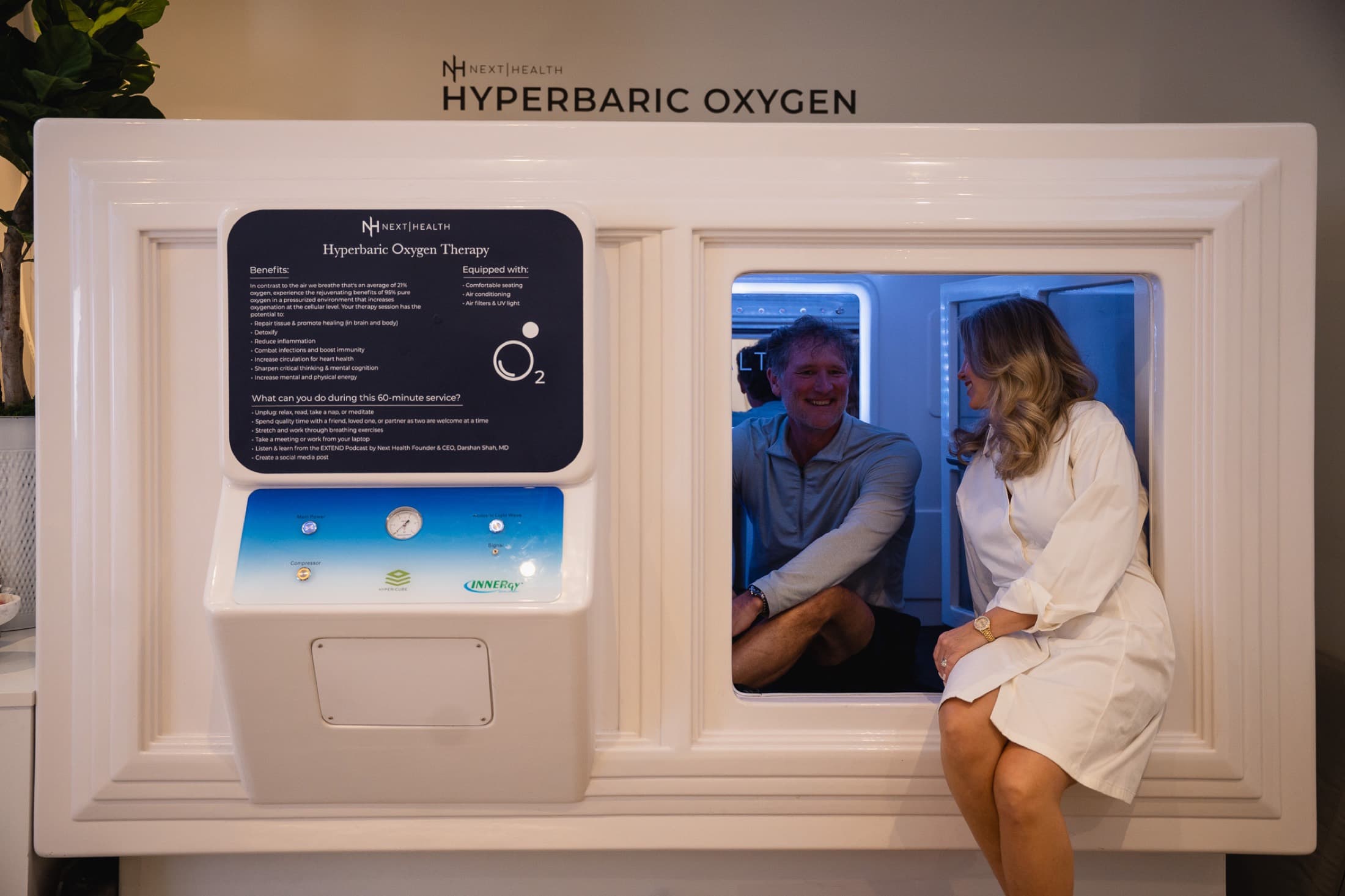
Hyperbaric oxygen therapy doesn't simply deliver more oxygen — it reawakens the body's own repair logic, reaching tissues that ordinary circulation can no longer serve.
There is a version of recovery that most of us have never actually experienced. Not the recovery of waiting — the sore muscles that loosen on their own, the inflammation that retreats because it has nowhere else to go — but something more deliberate. A recovery in which the body is handed exactly what it needs to do the work it already knows how to do, at a scale it couldn't reach on its own.
That is, in essence, the premise of hyperbaric oxygen therapy. And the more carefully you examine the underlying physiology, the more the premise holds.
What Changes When the Pressure Rises
Under normal conditions, the body delivers oxygen almost entirely through hemoglobin — the protein inside red blood cells that binds to oxygen molecules and carries them through the vascular system. It is an elegant system, and under ordinary circumstances, it does its job well. But elegance has limits. Hemoglobin can only carry so much, and it can only go where blood vessels go. Tissue that is chronically inflamed, damaged, or poorly perfused — tissue where capillary networks have thinned or where circulation has been compromised — receives less oxygen than it needs. Over time, those deficits compound.
Hyperbaric oxygen therapy intervenes at precisely this point. By breathing medical-grade oxygen inside a pressurized chamber — typically at 1.5 to 3 times normal atmospheric pressure — the body encounters a different physical law. Henry's Law, which governs how gases dissolve into liquids, dictates that under elevated pressure, oxygen dissolves directly into the blood plasma, the cerebrospinal fluid, the lymph, and the synovial fluid of the joints. It stops being a passenger that requires a carrier, and becomes something the tissue can absorb through simple diffusion. Regions of the body that have been quietly oxygen-deprived for years suddenly find themselves bathed in it.
The distinction between oxygen that is carried and oxygen that is dissolved may sound technical, but its implications are anything but. It is the difference between a supply route that can be blocked and one that cannot.
The Cascade That Follows
What happens next is where the science becomes genuinely interesting — and genuinely complex. Oxygenating starved tissue is not the end of the story; it is the beginning of a signaling cascade that researchers are still working to fully map.
Among the most studied effects is the modulation of HIF-1α, a master regulatory protein that governs how cells respond to oxygen availability. In states of chronic low-oxygen stress, HIF-1α essentially keeps cells in a kind of survival mode — conserving energy, suppressing repair, prioritizing persistence over regeneration. Hyperbaric oxygen appears to reset this system, shifting cells back toward a more regenerative mode of function. At the same time, research suggests that elevated oxygen environments suppress the activity of NF-κB, one of the primary drivers of the inflammatory cascade — with anti-inflammatory effects that may persist well beyond the session itself.
Mitochondria respond to the oxygen abundance as well. Cells that have been operating in a state of chronic energy deficit begin producing ATP — the body's fundamental energy currency — more efficiently. The downstream effects on cellular repair, protein synthesis, and tissue maintenance are measurable.
The chamber does not heal the body. It restores the conditions under which the body remembers how to heal itself.
There is also growing interest in HBOT's relationship to bone and tissue environments under duress. Recent research, including work examining oxygen's role in pain modulation for compromised tissue (Wang et al., 2026), points toward a broader picture of how pressurized oxygen interacts with biological systems that are struggling to self-regulate.
Recovery as a Biological Argument
It is worth stepping back from the mechanism for a moment and considering what recovery actually means at the cellular level. The conventional understanding — rest, nutrition, time — is not wrong, but it is incomplete. Recovery is fundamentally a process of biological argument: the body marshaling resources, sending signals, rebuilding structures that were stressed or damaged. What limits that argument, more often than we acknowledge, is not time. It is resources.
Oxygen is perhaps the most essential of those resources. The body uses it to:
- Power the mitochondrial processes that generate cellular energy
- Synthesize the proteins required for structural repair
- Drive the immune activity that clears damaged cellular material
- Regulate the inflammatory response that must activate and then resolve
When those processes are oxygen-limited — even subtly, even chronically — recovery becomes slower, less complete, and more costly. The system compensates rather than repairs.
Hyperbaric oxygen therapy, understood through this lens, is less about flooding the body with something foreign and more about restoring a condition the body's repair logic was designed to work within. The pressure is simply the mechanism by which that condition becomes achievable in tissues that could not reach it otherwise.
What remains striking, after all the physiology is laid out, is how much the body is still capable of — given the right inputs. Not rescued, not overridden, but supplied. There is something quietly optimistic in that. The architecture of repair is already present. It is waiting for conditions that make the work possible.