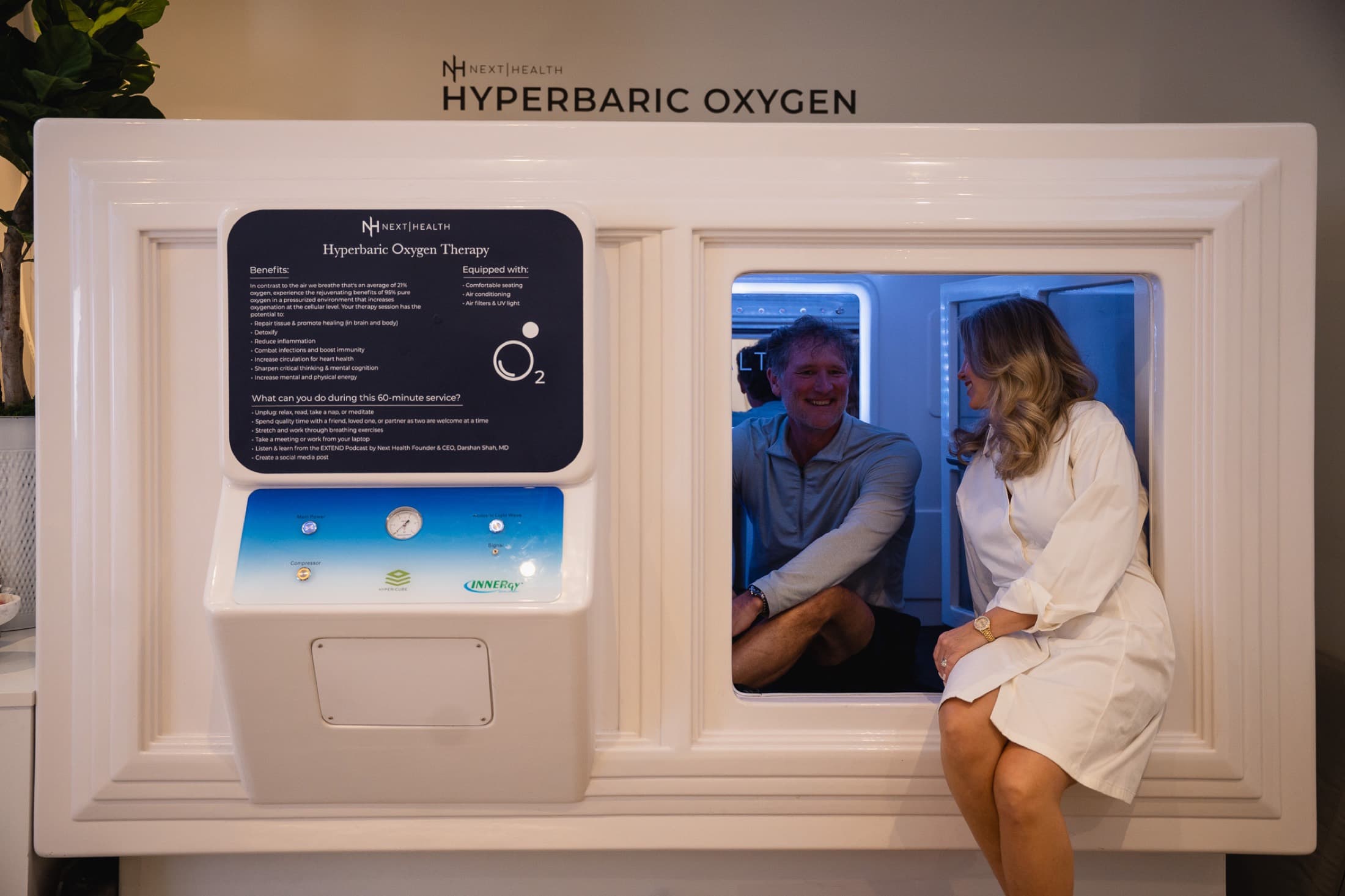
The Gradient the Body Learns to Cross: On Oxygen, Diffusion, and the Recovery Edge
Hyperbaric oxygen therapy works not just by delivering more oxygen, but by changing the physics of how oxygen moves through the body entirely.
There is a law of physics that most of us learned in school and then quietly forgot. Henry's Law tells us that the amount of a gas dissolved in a liquid is directly proportional to the pressure applied to it. It is the same principle that puts the carbonation in sparkling water — and it is the foundational reason that breathing oxygen inside a pressurized chamber produces effects that no amount of deep breathing on dry land ever could.
Under ordinary conditions, your blood carries oxygen in one primary way: bound to hemoglobin, the protein inside red blood cells that latches onto oxygen molecules and ferries them through the circulatory system. At sea level, breathing normal air, hemoglobin is already running near its maximum capacity. There is almost no oxygen dissolved freely in the plasma itself. The system is, in a sense, already maxed out before you take a single extra breath.
This is where the physics changes everything.
What Pressure Actually Does
Inside a hyperbaric chamber — at pressures typically ranging from 1.5 to 3 times normal atmospheric pressure — oxygen stops being solely a passenger on hemoglobin and begins dissolving directly into the plasma, the cerebrospinal fluid, the lymph, the synovial fluid in the joints. Plasma oxygen levels can rise to ten or fifteen times what is achievable breathing ambient air at sea level. And because this dissolved oxygen moves by diffusion rather than through vessel delivery alone, it can reach tissue that compromised circulation cannot.
That distinction is worth sitting with for a moment. Much of what we call aging, at the cellular level, involves tissue that has slowly been deprived of adequate oxygen — not dramatically, not acutely, but chronically, quietly, over years. Inflammation narrows the microvascular pathways. Damage accumulates in the spaces between. Cells that were once metabolically vibrant begin operating in a low-grade survival mode, their mitochondria producing energy less efficiently, their capacity for repair diminished. They are not dead. They are just running on a very thin margin.
"The body does not forget how to heal. It simply needs the conditions to remember."
Hyperbaric oxygen therapy appears to restore something closer to those conditions. Mitochondria, flooded with oxygen they have not had access to in some time, shift back toward more efficient ATP production. Cells that have been in a chronic hypoxic state begin to restore their capacity for protein synthesis, for signaling, for the ordinary repair processes that define healthy tissue function. It is not a dramatic event inside the chamber — most people report a quiet calm — but the downstream biology is anything but quiet.
The Signaling That Outlasts the Session
What makes hyperbaric oxygen genuinely interesting from a research standpoint is that its effects appear to extend well beyond the duration of a session. The oxygen itself is transient. The signaling it initiates is not.
One of the key mechanisms researchers have focused on involves hypoxia-inducible factor-1 alpha, or HIF-1α — a master regulatory protein that governs how cells respond to oxygen availability. When tissue has been chronically underserved by oxygen, HIF-1α keeps cells locked in a kind of low-oxygen survival program. Elevated pressure oxygen appears to help reset this regulatory state, shifting cells back toward regenerative function rather than mere survival. Separately, the hyperoxygenated environment has been associated with suppression of nuclear factor kappa B (NF-κB), a central driver of the inflammatory cascade — which may help explain why the anti-inflammatory effects of a session appear to persist for hours or days afterward.
There is also emerging research into what pressurized oxygen does at the level of gene expression more broadly — including effects on telomere length and the reduction of senescent cells, both of which sit at the heart of current longevity science. The data is early and the mechanisms are still being mapped, but the direction of the research is striking enough to warrant serious attention from anyone interested in the biology of aging.
The recovery applications are perhaps the most immediately intuitive. Athletes have long understood that the bottleneck in performance is often not the training itself but the recovery — the window between sessions when adaptation either happens or doesn't. Hyperbaric oxygen appears to compress that window for some people, accelerating the clearance of inflammatory markers and supporting the tissue repair processes that training demands. But the clinical interest extends well beyond sport:
- Wound healing in tissue with compromised circulation
- Neurological recovery following injury or chronic inflammation
- Reduction of post-exertional fatigue
- Support for conditions associated with chronic low-grade systemic inflammation
A Different Kind of Sufficiency
What draws thoughtful attention to hyperbaric oxygen therapy is not that it introduces something foreign to the body. It does not. Oxygen is the most fundamental substrate life runs on. What HBOT offers is a change in the physical conditions under which that oxygen is delivered — a way of getting more of what the body already needs into the places that have quietly stopped receiving it.
There is something almost philosophical in that. The body's capacity for repair is not always the limiting factor. The delivery system — the environment in which cells are asked to do their work — often is. Pressure, it turns out, is one of the most elegant ways we have of changing that environment without altering the substance of what we are giving. The oxygen is ordinary. The gradient it crosses, under pressure, is not. And it is across that gradient that something meaningful — and increasingly, measurably — happens.