Infrared Sauna and Red Light Therapy in Nashville: A Guide
A complete guide to infrared sauna and red light therapy in Nashville: how each works, what the research supports, how they differ, and where to go.
Infrared sauna and red light therapy both use specific wavelengths of light to act on the body, one mainly through gentle, penetrating heat and the other through light absorbed at the level of the cell. They are often offered side by side, and they are easy to confuse, but they work along different lines and are worth understanding separately. In Nashville both have become fixtures of recovery and longevity routines. This guide explains how each one works, what the research supports and what is still emerging, how infrared sauna differs from a traditional sauna, how heat and red light relate to one another, how to use them sensibly, and where to go.
What is infrared sauna, and how does it differ from a traditional sauna?
A traditional sauna heats the air in the room, and that hot air heats you. It can be intense, and for some people genuinely uncomfortable, because the experience depends on a high air temperature.
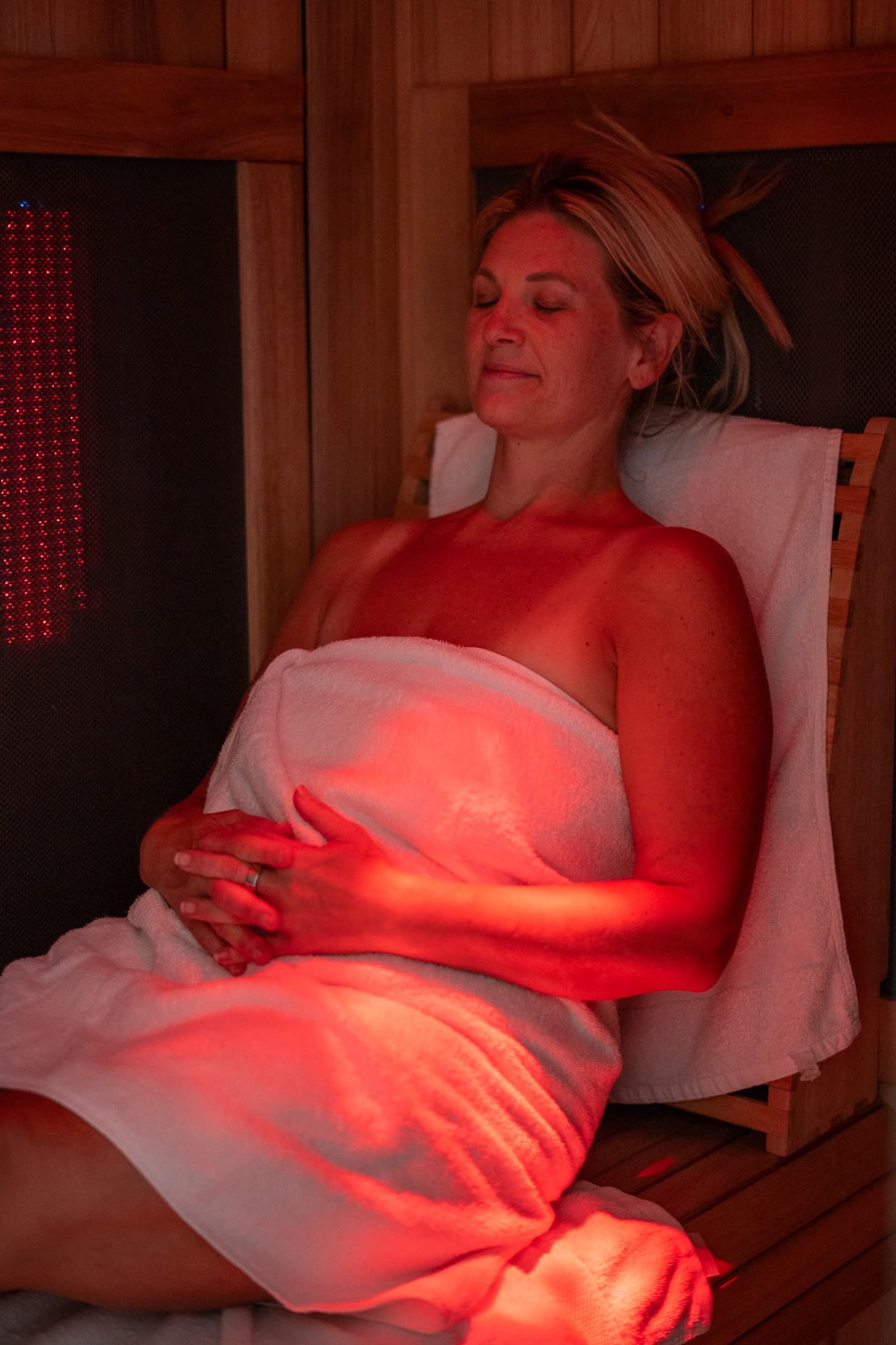
Infrared sauna takes a gentler route. It uses infrared light to warm the body directly, raising core temperature deeply while the surrounding air stays at a more moderate temperature. The physiological goal is the same, a meaningful rise in core heat, but the texture of the experience is different: calmer, more sustainable, closer to a long warm exhale than an endurance test. For many people that difference is what turns heat from an occasional event into a regular habit, and repetition is where the benefit tends to live.
Some infrared cabins are described by the bands they emit, near, mid, and far infrared, which penetrate to different depths. The practical takeaway is simpler than the terminology: infrared warms you from within rather than cooking the air around you, which is why a session can feel moderate and deep at the same time.
What happens to your body during an infrared sauna session?
When your core temperature begins to rise, your body cannot ignore it, and a coordinated response follows. Heart rate climbs. Blood vessels dilate. Circulation increases and redistributes toward the skin to shed warmth, and you begin to sweat. If a session leaves you feeling pleasantly worked, that instinct is accurate: your cardiovascular system has been doing real work the entire time.
This is the quiet reason deliberate heat is so interesting. It places a mild cardiovascular load on the body that resembles, in some respects, the load of light exercise, without the mechanical wear and accessible to almost anyone who can tolerate the warmth.
Heat also belongs to the same hormetic family as cold. It is a brief, manageable challenge that prompts the body to adapt. At the cellular level, heat prompts the production of heat shock proteins, molecules that help maintain and repair other proteins and that are part of how cells cope with stress in general. Practicing the heat response appears to keep this protective machinery in good working order.
The sauna is one of the few places where doing nothing places a genuine, beneficial demand on the body.
What is red light therapy, and how does it work?
Red light therapy, sometimes called photobiomodulation, is a different mechanism that happens to share the infrared label. Rather than relying on heat, it delivers specific wavelengths of red and near-infrared light to the body, often at intensities you barely feel as warmth at all.
Unlike visible light that mostly stops at the surface, red and near-infrared wavelengths penetrate into tissue. There, the leading explanation is that they interact with the mitochondria, the energy-producing structures inside your cells. The proposed effect is a modest support to cellular energy production and a gentle nudge to the cell's own repair processes. Research has explored red light in connection with skin quality, recovery, circulation, and tissue repair. The field is still maturing, and good practitioners say so plainly, but the direction of the findings is reasonably consistent and the underlying mechanism is plausible.
The simplest way to hold the distinction: infrared sauna works largely through heat and the body's response to it, while red light therapy works largely through light absorbed at the cellular level. They overlap in the infrared range, and they are often used together, but they are not the same intervention.
One reason red light draws so much attention is that it returns to the mitochondria, the same structures at the center of almost any honest conversation about energy and repair. If the leading explanation holds, red light is not adding a drug to the system so much as giving an existing process a small amount of support. That is a modest claim by design, and it is part of why the practice is usually framed as an addition to good habits rather than a standalone fix. The sensible posture is interest without overstatement: the mechanism is plausible, the early findings point in a consistent direction, and the dosing details are still being worked out.
What are the benefits of infrared sauna and red light therapy?
Both practices are studied for a cluster of related effects, and both are best understood as supportive inputs rather than treatments for any specific condition. Across the research and long practice, the associations most often reported include:
- Supported circulation and a general sense of relaxation and release from regular heat exposure
- Favorable cardiovascular signals from consistent sauna use, observed in large population studies
- Better engagement of the body's own stress-response and repair machinery, through heat shock proteins and, for red light, mitochondrial activity
- Interest in red and near-infrared light for skin quality, recovery, and tissue repair
The cautions matter as much as the list. Much of the sauna evidence is observational, meaning it shows association rather than proving cause, and the red light field is still early, with protocols and dosing that researchers are actively working out. Neither practice is a substitute for sleep, nutrition, movement, and daylight. They are additions to good habits, not replacements for them, and they are most useful when the foundations are already in place.
How do infrared heat and red light fit together?
It helps to see both as part of a larger truth about light and temperature: the body reads them as information, not just as ambiance. Light sets your internal clock, and a great deal of ordinary tiredness is, underneath, a clock that has not received a clear signal in years. Heat and specific wavelengths of light are two more channels through which the body takes in and responds to its environment.
In practice, infrared sauna and red light therapy are complementary. The sauna provides the whole-body heat stimulus and the cardiovascular load that comes with it. Red light provides a non-thermal signal aimed more directly at cellular energy and repair. Used thoughtfully, they can sit within the same restoration routine, each doing something the other does not. Neither one needs the other to be worthwhile, but together they cover more of the same restorative ground from different angles. For how infrared and light compare with pressurized oxygen as recovery tools, see our hyperbaric vs red light comparison.
What is a session actually like, and how often should you do it?
An infrared sauna session is unhurried by design. You sit in the warmth, usually for fifteen to forty minutes depending on the protocol and your tolerance, breathing and resting while your core temperature rises and you begin to sweat. The air feels moderate rather than punishing, which is much of the point, and you rehydrate afterward. A red light session is typically shorter and feels like little more than sitting near a warm, bright panel.
Both reward consistency over intensity. The benefits of heat and light, like the benefits of nearly everything in this space, come from repetition, so a comfortable practice you return to several times a week will reliably outperform an intense one you avoid. There is no need to chase the hottest room or the longest session. The aim is a sustainable rhythm your body can adapt to over time, and a provider can help set a cadence that matches your goals and how you respond.
There is a quiet assumption worth retiring here: the belief that anything good for us has to be unpleasant, that benefit and discomfort are somehow linked. Heat and light are a useful correction to that idea. The relaxation is not a distraction from the effect. The lowered stress, the quiet, the screen-free stillness are part of the point, and the fact that a practice is genuinely enjoyable is often exactly what makes it something you keep doing. Sometimes the most sophisticated thing you can do for long-term health is also among the simplest.
Who are these practices for, and who should be cautious?
Infrared sauna and red light therapy tend to appeal to people seeking restoration rather than strain: those managing the stress of a demanding schedule, active people supporting recovery, and anyone drawn to gentle, repeatable practices as part of a longevity routine. The low-friction, genuinely pleasant nature of both is part of why people actually keep them up.
That said, heat is not right for everyone. Pregnancy, certain cardiovascular conditions, low blood pressure or a tendency to feel faint, and some medications that affect heat tolerance or hydration are among the reasons to check with a provider before starting, and to build up gradually. Hydration is a real variable with heat, not an afterthought. Red light is generally well tolerated, though eye protection and sensible use still matter. Because both prompt real physiological responses, they are best matched against your history first, and a specific medical concern belongs with a physician rather than a lobby sign-up sheet.
Where can I get infrared sauna and red light therapy in Nashville?
Infrared sauna and red light therapy are offered across Nashville, from standalone studios to clinics that fold them into a broader recovery and longevity plan. The difference that matters is whether they are sold as one-off sessions or placed inside a program that considers your goals and pays attention to how you respond over time.
Next Health Nashville offers infrared and red light therapy at both of its locations, The Gulch (616 8th Ave South, Nashville, TN 37203) and Green Hills (3710 Hillsboro Pike, Nashville, TN 37215), typically alongside a wider restoration plan so the practice is matched to where you actually are rather than applied generically. You can read more on the infrared page, and the booking box below has both locations and phone numbers.
Wherever you go, a few questions tell you most of what you need to know. Is the practice placed inside a plan, or just sold by the session? Is the equipment well maintained and the protocol explained clearly? And is anyone paying attention to how you respond and adjusting accordingly? The answers separate a considered restoration practice from a quick add-on.