Hyperbaric Oxygen Therapy (HBOT) in Nashville: Benefits and Uses
A measured guide to hyperbaric oxygen therapy in Nashville: how pressure changes the physics of oxygen delivery, what the research supports, the difference between medical-grade and mild chambers, and where to go.
Hyperbaric oxygen therapy, or HBOT, works on a counterintuitive idea: the way to get more oxygen into the tissues that need it is not to breathe harder, but to change the pressure around the body. Inside a pressurized chamber, oxygen stops behaving the way it does at sea level and starts reaching places ordinary breathing cannot serve. It is one of the quieter interventions in longevity medicine, uneventful to experience and entirely cellular in its drama. This guide explains what HBOT is, the physics that make it work, what the research supports, how medical-grade and mild chambers differ, what a session feels like, and where to find it in Nashville.
What is hyperbaric oxygen therapy?
Oxygen is the most familiar thing in your life and the one you think about least. You will take roughly twenty thousand breaths today and notice almost none of them. That ease is a kind of blind spot, because the amount of oxygen actually reaching your tissues is not fixed, and under the right conditions it can be raised in ways ordinary breathing cannot achieve.
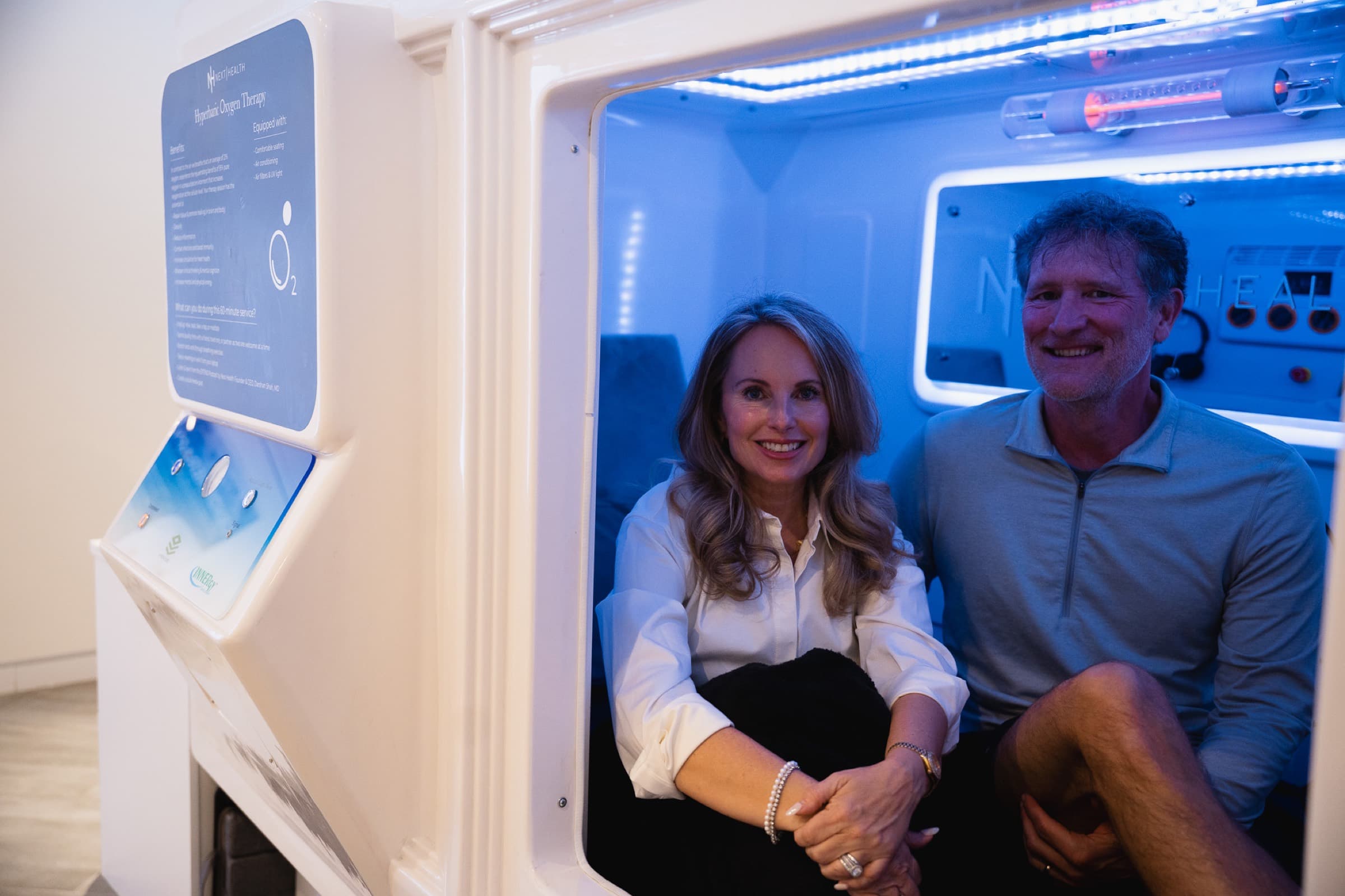
Hyperbaric oxygen therapy is the practice of resting in a chamber at increased atmospheric pressure while breathing oxygen-rich air. The session itself is calm: you sit or lie in a comfortable, pressurized chamber for around an hour, reading, resting, or closing your eyes. Nothing feels dramatic. What changes is the physics of how oxygen moves through the body, and that change is where the interest lies.
How does pressure change the way oxygen works?
Under everyday conditions, oxygen travels mostly by hitchhiking. It binds to hemoglobin in your red blood cells and rides along to wherever it is needed. The system is elegant and efficient, but it has a ceiling: once hemoglobin is saturated, breathing harder loads no more oxygen on board. The buses are full.
There is, however, a second route. Oxygen can dissolve directly into the plasma, the fluid your blood cells float in. Under normal pressure very little travels this way. It is a road that is technically open but almost empty. Hyperbaric oxygen therapy works by putting traffic on that empty road.
The mechanism is a principle from physics rather than medicine. Henry's Law holds that a gas dissolves into a liquid in direct proportion to the pressure applied to it. Inside a chamber, where pressure rises to roughly one and a half to three times what you experience at sea level, oxygen begins dissolving directly into the plasma, and into the cerebrospinal fluid, the lymph, and the synovial fluid around the joints. It reaches tissue by diffusion rather than by hemoglobin transport alone.
Ordinary breathing fills the buses. Pressure opens a second road, and lets the oxygen travel where the buses cannot.
This is not a subtle distinction. Tissues served by compromised circulation, areas of swelling, inflamed joints, or brain regions affected by the slow vascular changes of aging, can still be reached by dissolved oxygen moving through fluid. The delivery infrastructure becomes, in a meaningful sense, less limiting, and the fluid itself becomes oxygen-rich.
Why does an oxygen surplus matter?
Oxygen is not merely fuel. It is also a signal and a building material, and a genuine surplus is associated with several processes the body uses to repair and maintain itself. What makes HBOT interesting from a longevity standpoint is less the oxygenation itself than the signaling it appears to set off, much of which seems to persist after the session ends.
One mechanism involves HIF-1 alpha, a master regulatory protein that governs how cells respond to oxygen availability. Chronic low-oxygen conditions can lock cells into a survival mode that suppresses regeneration. Hyperbaric conditions appear to help reset that signaling, nudging cells back toward active, restorative function. At the same time, elevated oxygen appears to suppress NF-kappa B, a central driver of the inflammatory cascade, which may explain why the anti-inflammatory effect of a session seems to linger after pressure returns to normal. Research also associates repeated sessions with mobilization of stem cells from bone marrow and with support for collagen-building fibroblast activity.
The effects most consistently described across studies cluster around a few themes:
- Reduced inflammation: swelling tends to subside in a well-oxygenated environment, and the anti-inflammatory signal appears to outlast the session
- Tissue repair: healing is metabolically expensive, and oxygen is the currency the body spends to do it
- Mitochondrial support: cells operating in chronic oxygen deficit appear to restore ATP production when given abundant oxygen
- Cognitive clarity: the brain is among the most oxygen-hungry organs you own, and a richer supply is frequently described as a lift in focus
- Recovery capacity: for anyone asking a great deal of their body, the ability to repair quickly is often the quiet limiting factor
Can hyperbaric oxygen affect how tissue ages?
There is a particular kind of fatigue that sleep does not fix, the kind that accumulates not over days but over years. It tends to show up as tissue that regenerates more slowly than it once did, joints that take longer to settle, a mind that feels a step less clear than it did a decade ago. It is easy to file all of this under aging as though the word were its own explanation. A more specific idea is gaining ground: that a slow, quiet oxygen debt compiles at the cellular level, as circulation subtly declines and certain tissue beds spend years receiving less than they were built for.
This is where the plasma-diffusion mechanism becomes most relevant. Cells that have adapted to scarcity, downregulating their own repair activity to conserve energy, encounter a different chemical environment during a session and appear to begin responding accordingly. The reset of HIF-1 alpha signaling, the suppression of inflammatory drivers, and the renewed mitochondrial output described above are, in this framing, less a treatment imposed from outside than a temporary restoration of the conditions tissue was designed to operate in. The body already knows how to repair. What pressure and oxygen appear to offer, at their best, is a defined window in which stalled processes are given what they need to proceed. None of this halts aging, and researchers are still characterizing the effects, but it reframes some of what we accept as the simple wear of time as potentially more addressable than we assumed.
What does the research actually say about HBOT?
The honest answer is that the research is still accumulating, and measured enthusiasm is the right posture. Hyperbaric oxygen has a long, well-established clinical history in specific indications such as decompression sickness, certain non-healing wounds, and carbon monoxide poisoning. Its use for recovery, cognition, and longevity is a newer and more exploratory area, where biological plausibility is strong and the clinical evidence base is still maturing.
What appears consistent across the literature is a cluster of effects worth taking seriously: reduced markers of systemic inflammation after repeated sessions, improved mitochondrial function in tissues carrying a chronic low-grade oxygen deficit, support for recovery from soft-tissue and musculoskeletal stress, and neurological effects including reported improvements in cognitive clarity and sleep. None of this is magic, none of it is guaranteed, and none of it bypasses the fundamentals. But it fits a coherent framework. If repair is constrained by oxygen availability in compromised tissue, and if pressure can dissolve oxygen into that tissue through a physics-based mechanism, then the chamber is doing something structurally logical rather than merely speculative. Individual responses vary, and claims of specific outcomes deserve healthy skepticism.
What is the difference between medical-grade and mild chambers?
This is the distinction most worth understanding before you book anything, because the word "hyperbaric" is applied to very different equipment. Medical-grade, or hard-shell, chambers are rigid vessels that can safely reach higher pressures, often up to around three atmospheres, and deliver pure or near-pure medical oxygen under clinical oversight. Mild hyperbaric chambers, sometimes called soft or portable chambers, are flexible units that operate at much lower pressures, commonly around one and a third atmospheres, often with ambient or lightly concentrated air rather than pure oxygen.
Both can reasonably be called hyperbaric, but the dose of oxygen they deliver, and the depth of the physiological effect, are not the same. Lower-pressure mild chambers raise dissolved plasma oxygen far less than a medical-grade session does, and much of the research describing the signaling effects above was conducted at higher pressures with medical oxygen. Neither is simply better in the abstract. What matters is that you know which one you are using, at what pressure, with what gas, and under what supervision, so your expectations match the actual dose. A provider who cannot answer those questions clearly is not giving you enough to judge.
Who is HBOT for, and who is it not for?
There is something philosophically appealing about hyperbaric oxygen. It does not stimulate, push, or override anything. It removes a constraint, the supply ceiling, and lets the body's own repair machinery work with better materials. That makes it a natural fit for people focused on recovery and resilience over time, often as one input within a broader plan rather than a standalone fix.
It is not a substitute for the foundations. Sleep, nutrition, movement, and stress regulation still do the heavy lifting, and HBOT works best layered on top of them rather than in place of them. As with any therapy, it should be screened against your history first, and certain conditions, including some involving the ears, lungs, or recent surgery, require clinical review before pressure is appropriate. If you have a specific medical concern, that belongs with a physician, not a chamber menu.
Where can I get hyperbaric oxygen therapy in Nashville?
HBOT is offered across Nashville in a range of settings, from wellness lounges running mild chambers to clinics operating medical-grade equipment under supervision. The differences in pressure, gas, and oversight described above are exactly what to weigh when you compare them.
Next Health Nashville offers hyperbaric oxygen therapy at both of its locations, The Gulch (616 8th Ave South, Nashville, TN 37203) and Green Hills (3710 Hillsboro Pike, Nashville, TN 37215), under clinical supervision and usually alongside a baseline assessment, so the protocol is matched to your goals rather than guessed. You can read more on the hyperbaric oxygen therapy page, and the booking box below has both locations and phone numbers.
If you are deciding how HBOT compares with other recovery tools, our hyperbaric vs red light therapy guide walks through how the two work and where each one fits. And wherever you go, the questions that tell you the most are simple: what pressure does the chamber reach, what gas are you breathing, and who is supervising the session? The answers separate a genuine protocol from a pressurized hour sold on its own.