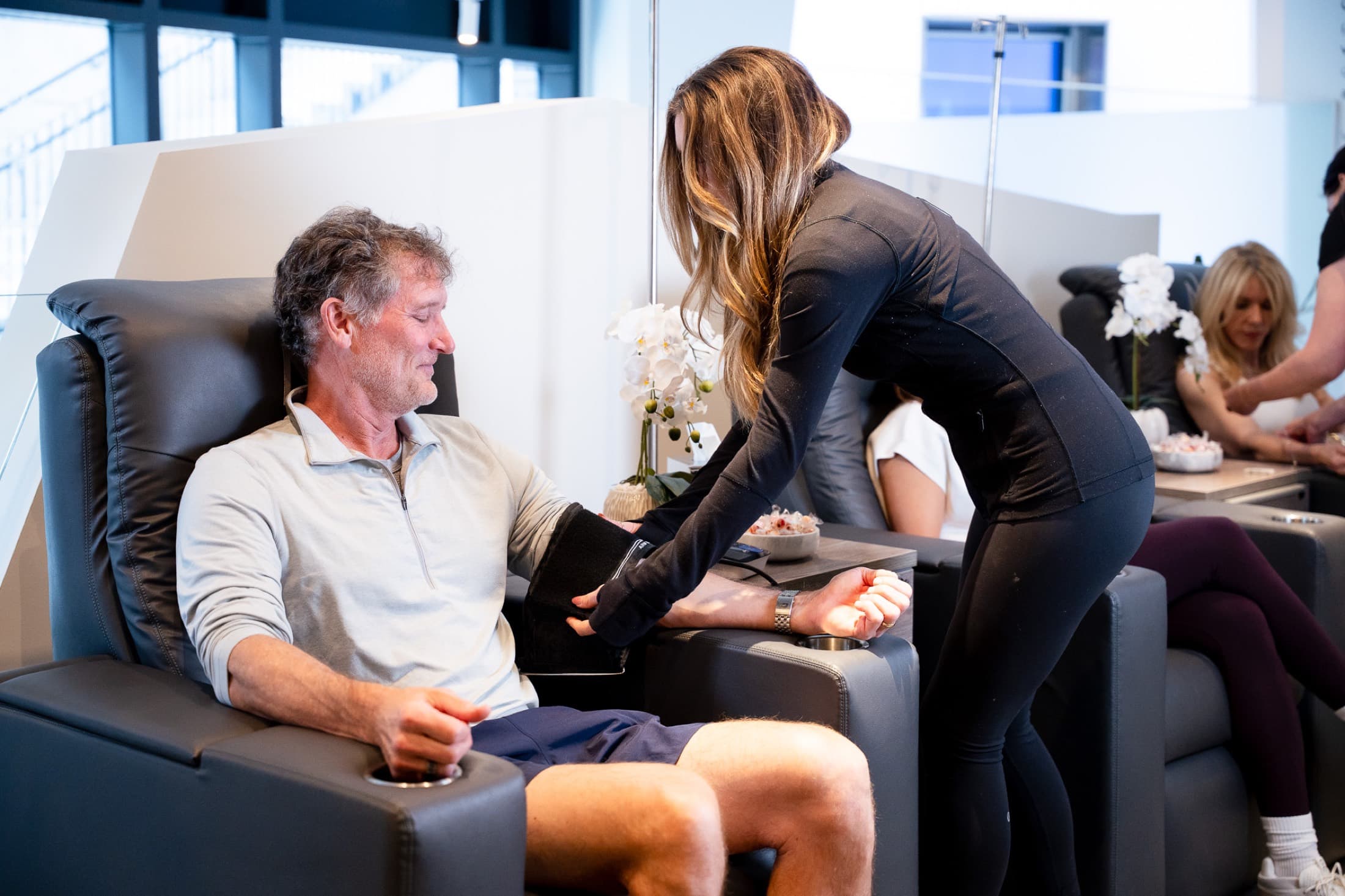
Muscle Recovery After Exercise: How the Body Repairs
What happens inside muscle and connective tissue after hard training, and how sleep, timing, and compression support repair.
Every athlete, at some point, has had the unsettling experience of feeling worse two days after a hard effort than immediately after it. The legs that carried you through a long run or a heavy training block grow heavier, stiffer, more indignant by Tuesday morning. This is not a failure of fitness. It is biology doing exactly what it was designed to do — and understanding the mechanism behind it changes how thoughtfully you might choose to respond.
Delayed-onset muscle soreness, the fatigue that accumulates in connective tissue, the low-grade inflammatory signal that persists after strenuous physical demand — these are not signs of damage to be suppressed. They are a biochemical conversation. The body is cataloguing what happened, recruiting repair resources, and laying down structural adaptations that will, eventually, make you more capable. The question worth asking isn't how to silence that conversation, but how to help it resolve more completely, and more intelligently.
What the Body Is Actually Doing
In the hours after significant physical effort, the body initiates a cascade that most people experience only as soreness but which represents an extraordinary feat of internal coordination. Microtrauma in muscle fibers triggers localized inflammation — not the chronic, low-grade inflammation associated with metabolic disease, but an acute, purposeful signal that calls satellite cells to the site, activates fibroblasts in the surrounding connective tissue, and begins the scaffolding process for repair.
The trouble is that this process has a rhythm, and modern life is often at odds with it. Sleep is compressed. Stress hormones remain elevated. Nutrition is inconsistent. Movement the following day — which research suggests actually aids lymphatic clearance and reduces inflammatory byproduct accumulation — gets skipped in favor of complete rest. The system designed for repair is running, but it's running in suboptimal conditions.
Compression, applied with appropriate timing and pressure, appears to work in part by assisting the mechanical components of this process — encouraging venous return, reducing interstitial fluid accumulation, and providing a consistent proprioceptive signal that may modulate the nervous system's interpretation of load. It is not magic; it is hydraulics, applied intelligently to a hydraulic problem.
"The body heals on its own schedule. Our role is to make sure that schedule isn't interrupted."
The Molecular Layer Beneath the Soreness
What is less often discussed is the molecular signaling environment in which all of this repair takes place. The structural work of recovery — rebuilding sarcomeres, remodeling fascia, restoring connective tissue integrity — depends on peptide signals that coordinate cellular behavior at a remarkably fine-grained level.
This is where research into short-chain peptides has begun to draw serious attention. BPC-157, a peptide derived from a protein found in gastric juice, has been the subject of a growing body of preclinical investigation exploring its apparent role in soft tissue repair. The research to date — much of it in animal models — suggests it may influence growth factor signaling, support angiogenesis in healing tissue, and modulate the behavior of fibroblasts, the cells primarily responsible for rebuilding collagen-rich structures like tendons and ligaments. A recent biopharmaceutical review by Mateescu et al., 2026 examined the translational development challenges facing BPC-157, noting both its compelling preclinical profile and the formulation complexities that make rigorous human trials technically demanding. The science is genuinely interesting, even if the clinical picture is still developing.
The broader point is this: what we call "recovery" is not a single event but a layered process, and different interventions address different layers. Compression works at the circulatory and mechanical level. Sleep works at the hormonal and glymphatic level — growth hormone secretion peaks during slow-wave sleep, and it is during those same hours that much of the body's most active tissue repair occurs. Peptide-based interventions, where appropriate, may work at the molecular signaling level, nudging the body's own repair intelligence in a more directed direction.
Building a Recovery Architecture
What emerges, if you think about it systematically, is something closer to a recovery architecture than a recovery habit. The components aren't interchangeable; they address different bottlenecks in the same process.
A few principles that appear consistently across the evidence:
- Timing matters more than intensity. Light movement within 24 hours of hard effort — a walk, easy cycling, mobility work — appears to support rather than hinder recovery by promoting circulation without adding new demand.
- Sleep is non-negotiable. No compression garment, no peptide, no cold or heat modality substitutes for adequate slow-wave sleep. The hormonal milieu of deep sleep is the original recovery therapy.
- Inflammation is not the enemy. Reflexively suppressing acute post-exercise inflammation with NSAIDs may actually blunt some of the adaptive signal. The goal is resolution, not suppression.
- Connective tissue heals slowly. Muscles often feel ready before tendons and fascia are. The tissue that holds structure together deserves as much attention as the tissue that generates force.
Recovery, understood this way, is less about what you do in the hours after effort and more about the environment — biological, hormonal, molecular — that your body inhabits over time. High-performance tissue isn't built in the gym. It is built in the quiet, unremarkable hours between the work, when the body is doing the most sophisticated thing it knows how to do: remembering what happened, deciding what it needs, and rebuilding accordingly. Our job is simply to give it the conditions to do that well.