Whole-Body Cryotherapy in Nashville: Benefits, Science, Where to Go
A complete guide to whole-body cryotherapy in Nashville: what it is, what happens in your body during a session, what the research supports, and where to go.
Whole-body cryotherapy exposes you to extremely cold air for a few minutes to trigger a coordinated stress response that your body treats as a signal to adapt. In Nashville it has moved from a niche athletic recovery tool into a regular fixture of longevity and performance routines, available everywhere from gym add-ons to clinical wellness programs. This guide explains what cryotherapy actually is, what happens inside your body during a session, which benefits the research supports and which are still emerging, how it compares to a cold plunge, what a session feels like, how often to do it, and where to have it done well.
What is whole-body cryotherapy?
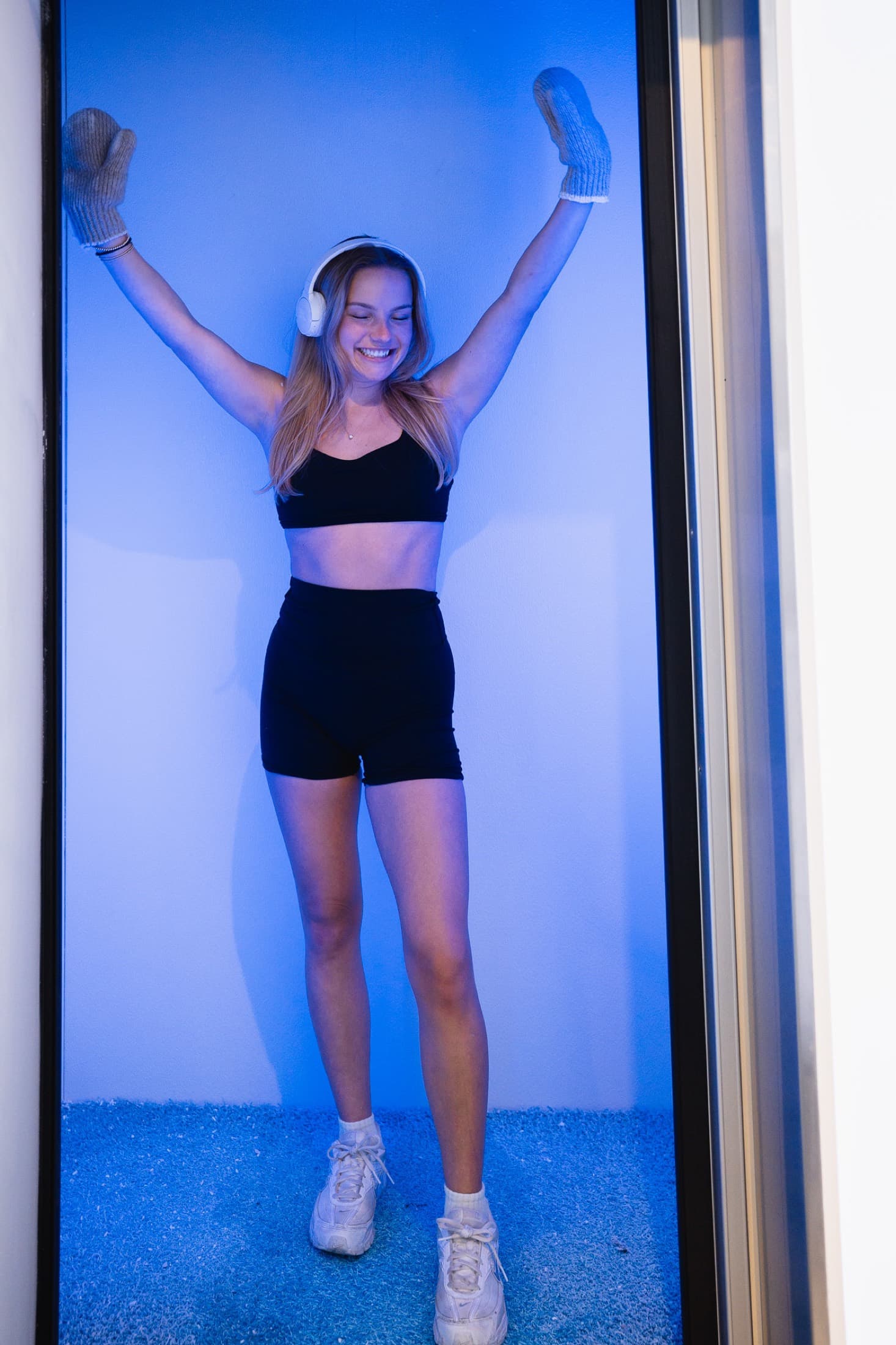
Whole-body cryotherapy is brief, controlled exposure to extremely cold air, typically in the range of -200°F to -250°F, for two to four minutes inside a specialized chamber. You stand in the chamber with your skin largely exposed, wearing minimal dry clothing plus protective coverings for your hands, feet, and ears, while a column of chilled air surrounds you.
It helps to separate a few things that often get grouped together. Localized cryotherapy targets a single joint or area rather than the whole body. An ice bath or cold plunge immerses you in cold water, which conducts heat away far more aggressively than air. Whole-body cryotherapy sits apart from both: it uses very cold, very dry air for a short window, which is why the temperatures sound more alarming than the experience actually is. Dry cold at -220°F does not transfer heat the way water at 50°F does, and that difference in medium is central to how the two practices feel and function.
The brevity is not a shortcut. It is the design. A session is meant to deliver a sharp, survivable stimulus and then end, so the body can move into the recovery phase where most of the useful adaptation is thought to occur.
What happens to your body during a cryotherapy session?
When the skin's cold receptors flood the nervous system with signals, the body does not simply register that it is cold. It organizes a response. Blood is drawn away from the surface and toward the core in a process called vasoconstriction, protecting your central temperature and vital organs. The nervous system sharpens. The adrenal system engages, and norepinephrine, a signaling molecule involved in mood, focus, and the regulation of inflammation, rises sharply. Research suggests norepinephrine can increase substantially after a single session, with commonly cited estimates in the range of 200 to 300 percent, a larger response than most everyday cold exposure produces.
Then the session ends and you rewarm. Blood that had withdrawn to the core flows back outward to the periphery, and circulation redistributes. That swing, constriction followed by return, is the event your physiology is responding to, not the cold alone.
The framework underneath all of this is hormesis: the principle that a brief, controlled dose of stress can leave a system better prepared than it found it. A small challenge, met and recovered from, becomes a stimulus to adapt rather than an injury to heal.
Cold does not make the body tougher by harming it. It makes the body more adaptable by asking something of it, briefly, and then letting go.
Repeated over weeks, that rehearsal appears to shift how the system behaves at rest. The body, introduced again and again to a precise and survivable cold stress, seems to respond with steadier regulation rather than a one-time jolt. Inflammatory responses become more measured. Recovery windows may shorten. The baseline the body returns to can move in favorable directions.
This is why cold has a place in a longevity practice rather than only an athletic one. A recurring thread in longevity research is that the body does not thrive on comfort alone. It thrives on calibrated challenge, exercise, fasting windows, heat, cold, followed by adequate recovery. The challenge signals that adaptation is necessary. The recovery is where adaptation actually happens. Two to three minutes of intense cold, followed by warmth and rest, is not suffering. It is a stimulus that is specific, bounded, and purposefully brief, and over time the lesson it teaches the body, to absorb a disruption, recalibrate, and return, is a broadly useful one.
What are the benefits of whole-body cryotherapy?
The honest framing is that cryotherapy is studied for a cluster of related effects, some better supported than others, and that it is best understood as one input into recovery and resilience rather than a treatment for any specific condition. Across the available research and a long history of practice, regular use has been associated with:
- Reduced markers of systemic inflammation, including C-reactive protein, in some studies
- Improved autonomic nervous system balance, reflected in measures such as heart rate variability
- Favorable shifts in mood and subjective alertness, potentially linked to norepinephrine and endorphin activity
- Faster perceived recovery after hard training in both athletic and non-athletic groups
A few points of caution belong alongside that list. Much of the evidence is still accumulating, sample sizes are often small, and association is not the same as cause. Researchers are right to be measured about how much any single mechanism explains. What can be said fairly is that the pattern across studies is coherent, and that the effects people most reliably report, a sense of clarity and steadier energy in the hours and days after sessions, are consistent with the physiology described above.
It is also worth being clear about what cryotherapy is not. It is not a stimulant that makes you feel electric in the chamber, and it is not a substitute for the foundations of health. Sleep, nutrition, movement, and stress management still do the heavy lifting. Cryotherapy is better thought of as a calibrated challenge layered on top of those, useful to the degree that the rest of the picture is in order.
How is cryotherapy different from a cold plunge?
Cryotherapy and cold water immersion aim at a similar idea through very different means, and the choice between them usually comes down to what you are after and what you can sustain. We cover this in detail in our cryotherapy vs cold plunge comparison, but the short version is a matter of medium, depth, and duration.
A cold plunge uses water, which pulls heat from the body quickly and reaches a deeper, more sustained cold that many people feel for longer. Sessions tend to run longer than cryotherapy and demand a different kind of composure, because water does not let you forget it is there. Whole-body cryotherapy uses dry air for a much shorter window, which makes the stimulus sharp but brief and, for many people, easier to fold into a regular schedule. Neither is simply better. They are different tools, and some people use both, choosing the plunge for depth and cryotherapy for repeatable, low-friction exposure.
What does a cryotherapy session actually feel like?
The experience is calmer than the temperature suggests. You change into minimal dry clothing and put on the protective coverings for your extremities, then step into the chamber, usually with an attendant present the entire time. For the next two to three minutes you stand in the cold air, often moving slightly, while the attendant talks you through it.
The first thirty seconds are the most striking, a bracing, full-body alertness rather than pain. After that, many people settle into it, and the session ends before it becomes genuinely difficult. You step out, rewarm, and most people describe a distinct lift in the minutes that follow: brighter, more awake, more present. There is no downtime, and you return to your day immediately.
There is also something clarifying about the experience itself. You cannot do cold exposure half-heartedly or distract your way through it. You are either in it or you are not, and in a culture of partial attention, a few minutes of unavoidable presence can be its own small reset, separate from any physiological effect.
How often should you do cryotherapy?
Cryotherapy rewards consistency over intensity. A few short sessions a week, done regularly, tend to do far more than an occasional ordeal, because the benefit appears to live in repetition rather than in any single heroic exposure. For someone using it to support recovery from training, sessions are often timed around harder workouts. For someone using it more broadly for resilience and mood, a steady weekly rhythm is the usual approach.
The goal is not to prove anything or to chase colder and longer. It is to give the body a small, repeatable challenge it can adapt to, and then to let recovery do its work. A clinician or trained provider can help match the cadence to your training load, your goals, and how you respond.
Who is cryotherapy for, and who is it not for?
Cryotherapy tends to appeal most to people managing a real recovery demand or looking to build resilience deliberately: athletes and active people clearing the soreness of hard training, high-stress professionals seeking a reliable reset, and those drawn to hormetic practices as part of a longevity routine. In those situations, the short, repeatable nature of the stimulus is a genuine advantage.
It is not appropriate for everyone, and this is where supervision matters. Certain cardiovascular conditions, uncontrolled high blood pressure, pregnancy, and conditions involving cold sensitivity such as Raynaud's or cold urticaria are among the reasons a provider may advise against it or screen carefully first. Because the cold prompts a real cardiovascular and nervous-system response, it should be matched against your medical history before you begin, not treated as a casual drop-in. If you have a specific medical concern, that conversation belongs with a physician rather than a lobby sign-up sheet. And as with everything in this space, cryotherapy supplements the basics rather than replacing them.
Where can I get whole-body cryotherapy in Nashville?
Whole-body cryotherapy is offered across Nashville, from gym and studio add-ons to clinics that place it inside a broader, data-led plan. The difference that matters is whether it is sold as a one-off session or integrated into a program that starts with an assessment and pays attention to how you respond over time.
Next Health Nashville offers whole-body cryotherapy at both of its locations, The Gulch (616 8th Ave South, Nashville, TN 37203) and Green Hills (3710 Hillsboro Pike, Nashville, TN 37215), under trained supervision and typically alongside a wider recovery and performance plan, so the practice is matched to where you actually are rather than applied generically. You can read more on the cryotherapy page, and the booking box below has both locations and phone numbers.
Wherever you go, a few questions tell you most of what you need to know. Is the session supervised by trained staff who screen your history first? Is it placed inside a plan, or just sold by the session? And is anyone paying attention to how you respond and adjusting accordingly? The answers separate a considered practice from a quick add-on.