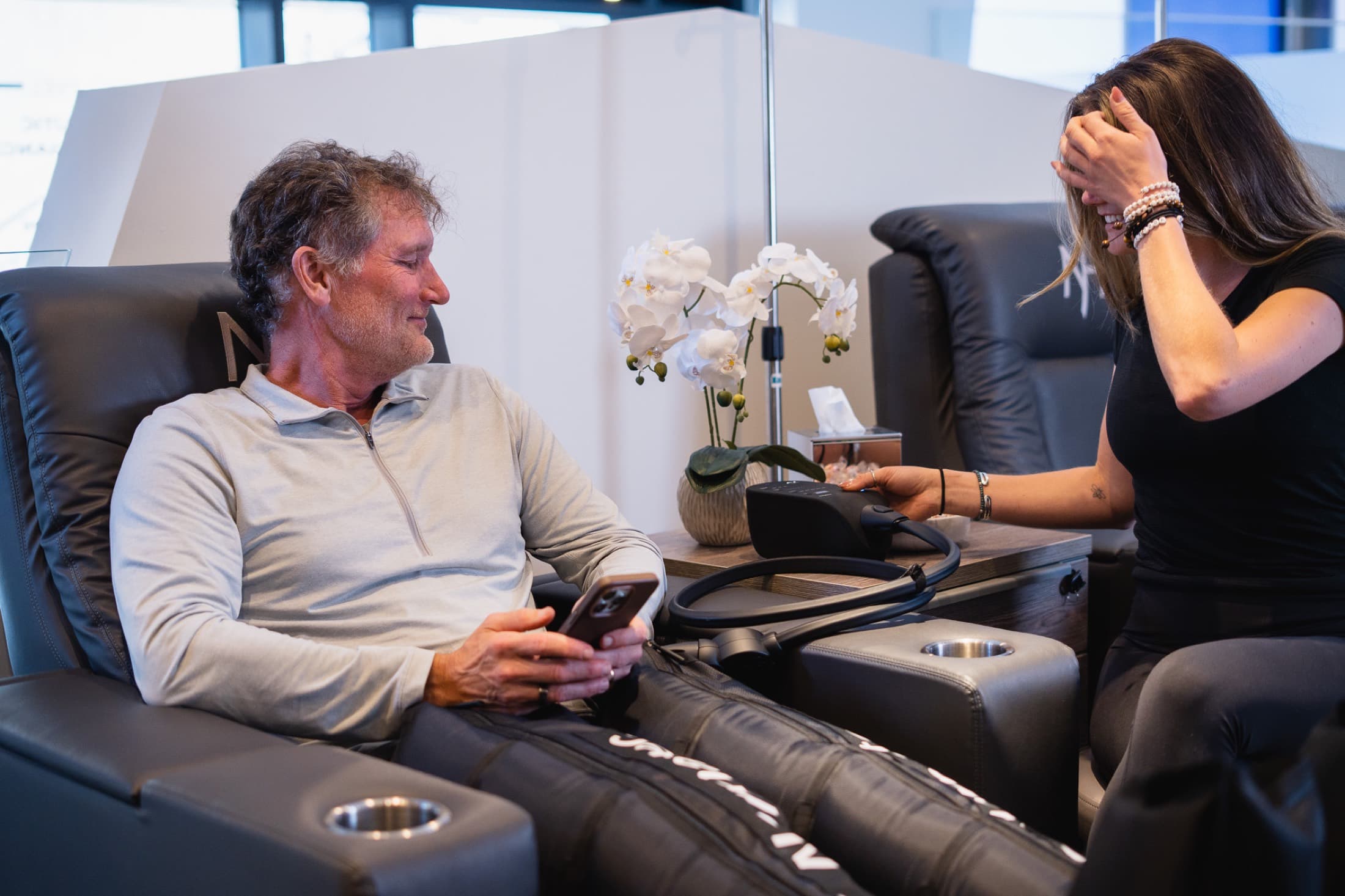
Infrared heat and red light work through different physics, but they share a common logic: asking the body to adapt without asking it to perform.
There is something philosophically interesting about therapies that require you to do nothing. No output, no exertion, no measurable performance to optimize in the moment. You simply sit — in warmth, in light — and the biology quietly reorganizes itself around the experience. For people accustomed to tracking effort, this can feel almost suspicious. But the body has never cared much about effort for its own sake. What it cares about is signal. And infrared heat, alongside therapeutic red and near-infrared light, turns out to be a remarkably eloquent one.
What Happens When the Temperature Rises
Infrared sauna works differently from traditional convective heat. Rather than warming the air around you and letting that warmth conduct inward, infrared wavelengths penetrate the skin directly, elevating tissue temperature from within. The sensation is gentler than a Finnish-style steam room, but the biological response is not gentle at all — it is, in the best sense, a controlled provocation.
As core temperature rises, the cardiovascular system responds with meaningful urgency. Heart rate increases, peripheral blood vessels dilate, and cardiac output climbs in ways that research suggests mirror the hemodynamic demands of moderate aerobic exercise. A 2026 study by Chavez et al. found that acute passive heat exposure produced measurable improvements in vascular function — a finding with implications not just for athletes but for populations where active exercise capacity is compromised (Chavez et al., 2026). The vessels, it turns out, don't always need the muscles to drive the adaptation.
Alongside the cardiovascular response, heat stress activates a class of proteins called heat shock proteins — molecular chaperones that repair misfolded proteins, protect cellular machinery from damage, and appear to play a meaningful role in the body's long-term resilience to stress. Regular hormetic heat exposure may also support the release of growth hormone and influence pathways associated with metabolic regulation. None of this requires intensity. It requires consistency, and a willingness to sit still long enough for the signal to land.
"The sauna does not ask you to perform. It asks you to receive — and in that receiving, something in the biology begins to harden, quietly, in exactly the right way."
The Light Layer Beneath the Heat
Red light therapy — more precisely called photobiomodulation — operates through an entirely different mechanism, though it is often paired with infrared sauna in recovery-focused protocols, and the pairing is not arbitrary. While infrared heat works broadly across tissue temperature and circulation, therapeutic red and near-infrared light work at the level of the mitochondria, and the specificity of that mechanism is what makes the research so compelling.
The relevant target is a mitochondrial protein called cytochrome c oxidase — the terminal enzyme in the electron transport chain, responsible for the final step in converting nutrients into ATP. What makes this protein unusual is that it is also a photoreceptor: it absorbs light in the red and near-infrared spectrum and uses that absorbed energy to drive ATP production more efficiently. When near-infrared photons reach this enzyme, they appear to displace nitric oxide that has been suppressing mitochondrial function — particularly relevant in chronically stressed or aging cells — allowing the respiratory chain to resume more vigorous activity.
The downstream effects of that restored mitochondrial efficiency are broad:
- Enhanced cellular energy availability for protein synthesis and repair
- Activation of Nrf2, the body's master antioxidant regulatory pathway
- Modulation of inflammatory signaling in ways associated with reduced chronic inflammation
- Improved circulation at the microvascular level, supporting tissue oxygenation
Red light in the 630–700nm range reaches the skin and upper subcutaneous tissue. Near-infrared light, in the 800–1000nm range, penetrates considerably deeper — into muscle, joint, and connective tissue. Clinical-grade devices typically combine both wavelengths, which is why the therapy's effects aren't limited to the surface. It is reaching places that most recovery tools simply cannot.
Why Stillness Is the Point
What infrared sauna and red light therapy share — beyond their physics — is a particular relationship with the body's recovery state. Both are most effective when the nervous system is not in active sympathetic drive. Both ask the body to receive rather than produce. And both appear to compound in their effects over time, with consistent exposure building adaptations that a single session cannot.
This is worth sitting with, especially for people who tend to measure wellness exclusively through output — lifts, miles, metabolic markers, sleep scores. Restoration is not the absence of progress. It is, in many cases, where progress actually consolidates. The heat and the light do not replace the work you've done. They create the conditions under which the body is finally willing to act on it.
There is an older idea in physiology — stress, then rest, then adaptation — that every serious practitioner knows intellectually but that modern schedules make surprisingly difficult to honor. Infrared sauna and red light therapy don't solve that scheduling problem. But they do make the recovery half of the equation more deliberate, more measurable, and — given what the research continues to suggest — considerably more potent than passive rest alone.