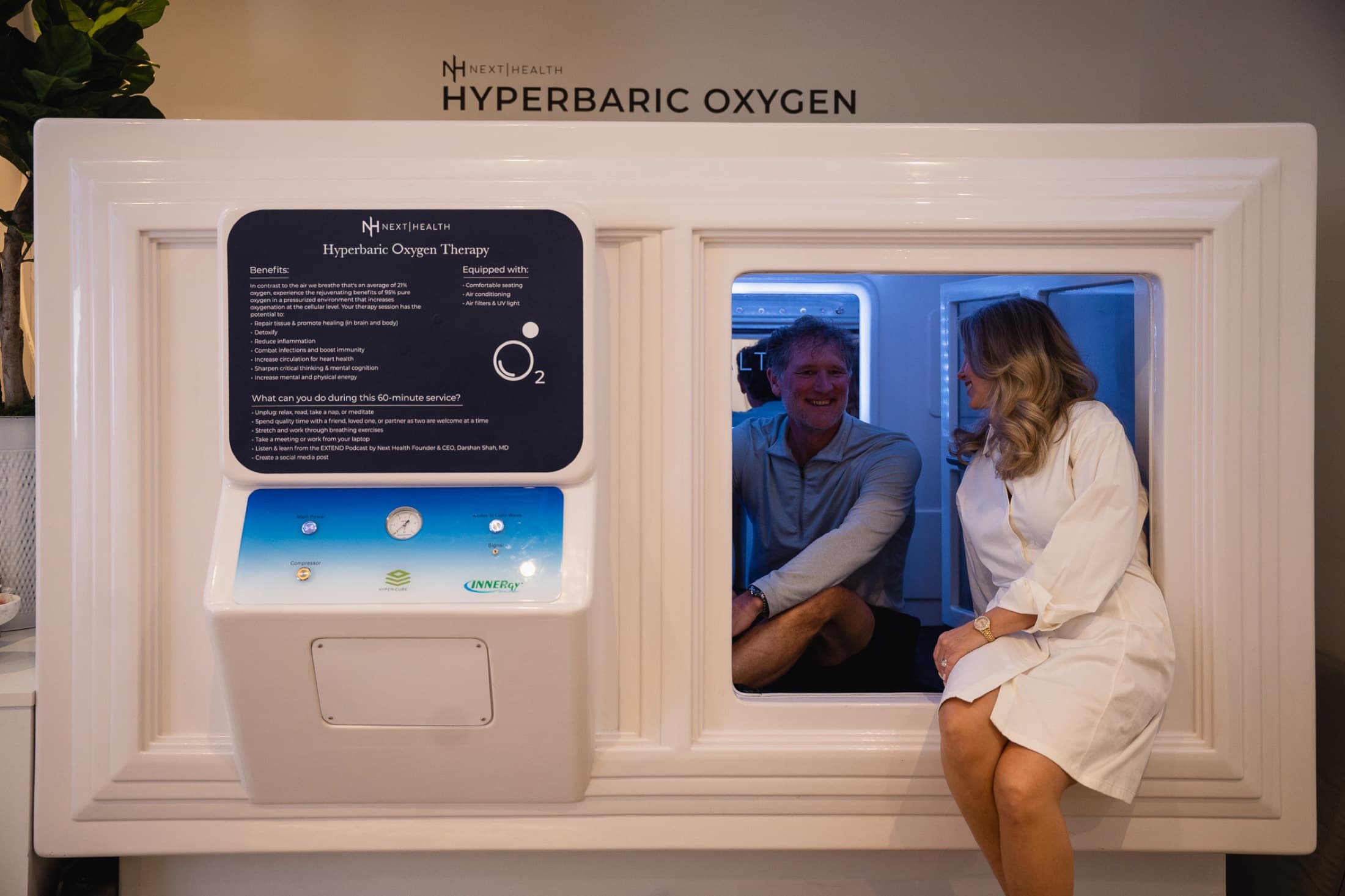
We breathe oxygen every moment without thinking about it. Change the pressure, and the same molecule starts behaving in ways the body cannot reach on its own.
Oxygen is the most familiar thing in your life and the one you think about least. You will take roughly twenty thousand breaths today, and notice almost none of them.
That ease is a kind of blind spot. Because the amount of oxygen actually reaching your tissues is not fixed — and under the right conditions, it can be increased in ways that ordinary breathing simply cannot achieve.
How oxygen normally travels
In everyday conditions, oxygen moves through the body mostly by hitchhiking. It binds to hemoglobin in your red blood cells and rides along to wherever it is needed. This system is elegant and efficient, but it has a ceiling: once hemoglobin is saturated, breathing harder does not load more oxygen on board. The buses are full.
There is, however, a second route. Oxygen can also dissolve directly into the plasma — the fluid your blood cells float in. Under normal pressure, very little travels this way. It is a road that is technically open but almost empty.
Hyperbaric oxygen therapy works by putting traffic on that empty road.
What pressure changes
Inside a hyperbaric chamber, the body rests in an environment of increased atmospheric pressure. That pressure does something specific and physical: it drives far more oxygen into solution in the plasma.
The result is that oxygen can now reach places the hemoglobin route struggles to serve — tissue with compromised circulation, areas of swelling, regions where healing has stalled for want of supply. The fluid itself becomes oxygen-rich, and fluid goes everywhere.
Ordinary breathing fills the buses. Pressure opens a second road, and lets the oxygen travel where the buses cannot.
Why a surplus matters
Oxygen is not merely fuel. It is a signal and a building material. A genuine surplus of it is associated with several processes the body uses to repair and maintain itself:
- Reduced inflammation. Swelling tends to subside in a well-oxygenated environment.
- Tissue repair. Healing is metabolically expensive, and oxygen is the currency.
- Cognitive clarity. The brain is among the most oxygen-hungry organs you own; a richer supply is frequently described as a lift in focus and mental energy.
- Recovery capacity. For anyone asking a great deal of their body, the ability to repair quickly is the quiet limiting factor.
A session is, by design, uneventful. You sit in a comfortable, pressurized chamber for around an hour. You can read, rest, or simply close your eyes. The drama is entirely cellular.
A therapy of patience
There is something philosophically appealing about hyperbaric oxygen. It does not stimulate, push, or override anything. It simply removes a constraint — the supply ceiling — and lets the body's own repair machinery work with better materials.
That is a recurring theme in thoughtful longevity work. The most durable interventions are rarely the ones that force an outcome. They are the ones that clear an obstacle and then step back, trusting a body that, given what it needs, is remarkably good at maintaining itself.
Oxygen under pressure is exactly that kind of intervention: an old, abundant molecule, delivered in a way that finally lets it finish the job.